The promo rate ended in March. Nobody called to warn you; the bill just jumped. If that sounds familiar, you are probably weighing IPTV vs cable in Canada for the first time, and you want more than a sales pitch.
So let's run it like a fight card. Six rounds (cost, channels, equipment, contracts, picture quality and flexibility), with a clear winner declared for each one, including the rounds cable still takes. By the end, you will know which option fits your household, and how to switch without losing a single game.
IPTV vs Cable Canada: The Quick Verdict
If you only have a minute, here is the summary.
| Round | Winner | Why |
|---|---|---|
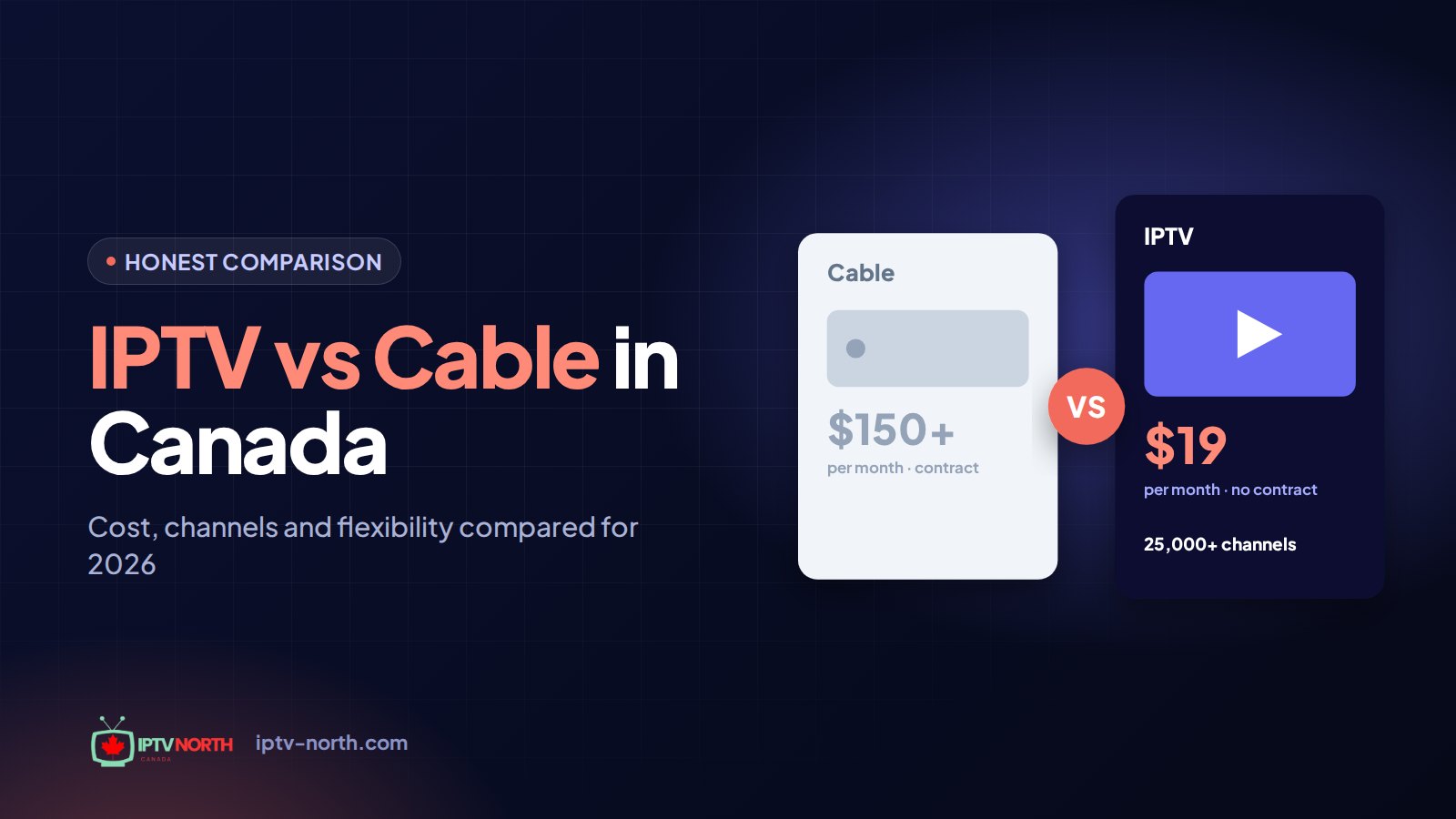
| Cost | IPTV | $19 for one month, or $79 for a full year, versus a cable bill that is often over $100 a month |
| Channels and sports | IPTV | 25,000+ live channels with Canadian sports included, no sports tier |
| Equipment and setup | IPTV | Uses devices you already own; no technician, no box rental |
| Contracts | IPTV | No contract, no cancellation fee |
| Picture quality | Tie | Both deliver HD; IPTV adds 4K and FHD on many channels |
| Reliability without internet | Cable | A dedicated line does not depend on your home network |
The rest of this article explains each call, with numbers and real-life scenarios.
Two Very Different Ways to Get TV Into Your Home
Understanding the delivery method explains most of the differences that follow.
Cable sends a large bundle of channels down a coaxial or fibre line to a set-top box at a fixed address. The provider controls the box, the lineup and the packages. You pay for the whole bundle whether you watch it or not.
IPTV streams a channel only when you select it, over the internet connection you already pay for. The "box" is any compatible device: a Fire TV Stick, a Smart TV, an Android TV box, a phone, a computer. Because there is no physical network to install at each address, the service can follow you from room to room and even out of the house.
That single difference, dedicated line versus your own internet, shapes the whole comparison.
Round 1: What You Actually Pay Each Year
Cable pricing in Canada tends to look friendly in the first year and much less friendly after. Introductory offers from the big providers are usually tied to a term, and once the term ends, the price returns to the regular rate. Extra boxes, sports add-ons and equipment fees then stack on top.
Here is a typical picture for a household that wants TSN and Sportsnet:
| Cost line | Cable (typical ranges) | IPTV North |
|---|---|---|
| Base TV package after promo | Roughly $80–$120 per month | Included in your plan |
| Sports channels (TSN, Sportsnet) | Often a separate add-on | Included |
| Receiver or PVR rental | Monthly fee per TV on many plans | $0, you use your own device |
| 4K channels | Limited, sometimes extra | 4K and FHD included |
| Leaving early | Possible early termination fees | $0, no contract |
| One full year | Often well over $1,000 | $79 (12-month plan) |
IPTV North keeps its prices simple, in Canadian dollars, for one device:
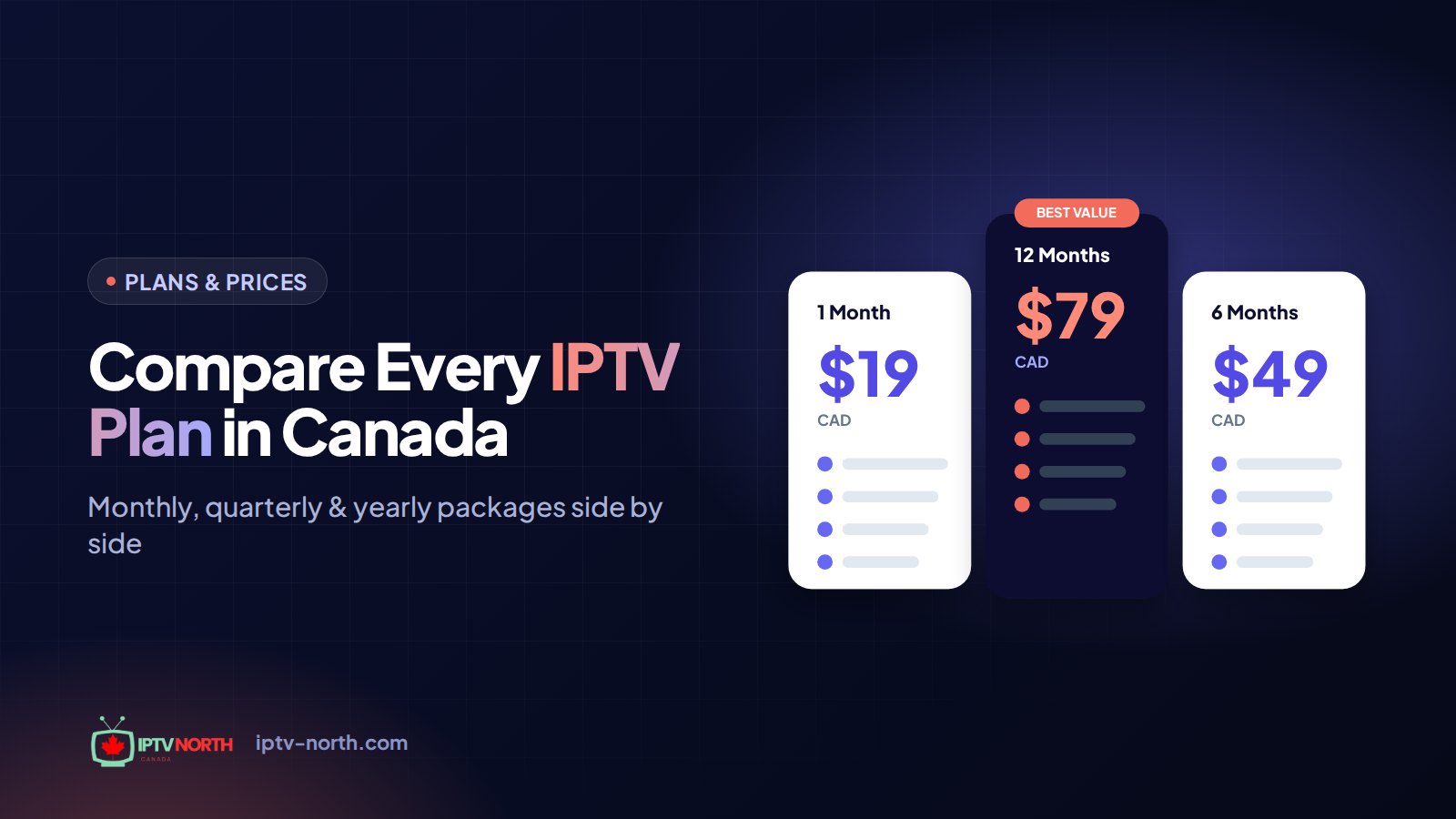
- 1 month: $19
- 3 months: $29
- 6 months: $49
- 12 months: $79 (about $6.60 a month)
Do the five-year math on a modest cable bill of $120 a month and you get $7,200. Five annual IPTV North plans total $395. Even if your cable bill is lower, the gap stays large. You can check every option on the IPTV pricing page.
Round 1 winner: IPTV, and it is not close.
Round 2: Channel Lineup and Canadian Sports
Cable packages in Canada commonly carry a few hundred channels, split into tiers. Specialty sports, French-language sports outside Quebec, and international channels are often sold as extras.
With IPTV North, the lineup is flat: one plan, everything included.
- 25,000+ live channels: Canadian networks (CBC, CTV, Global, Citytv, TVA, Radio-Canada), US networks, and a long list of international channels
- Canadian sports: TSN, Sportsnet, RDS, TVA Sports and CBC, for NHL, CFL, Raptors, Blue Jays and more
- 120,000+ movies and series on demand, available whenever you want
- Multicultural content for South Asian, Arabic, Filipino, Latin American, Caribbean, European and other communities
Picture a Leafs fan living in Moncton, or a Canadiens fan who moved to Kelowna. On cable, following a team outside its home market can mean extra packages. On IPTV, the regional Sportsnet feeds and RDS are simply in the list. Our guide to following every Canadian NHL team shows how that looks on a busy night.
Round 2 winner: IPTV.
Round 3: Equipment, Installation and Moving Day
With cable, a technician usually installs the service, and each TV needs its own receiver. Move from a condo in Mississauga to a house in Oakville, and you are booking another appointment and returning hardware.
With IPTV, setup is self-serve and quick:
- Start the $2.99 24-hour trial or choose a plan.
- Receive your login by email.
- Install a player on your device.
- Sign in and watch.
It works on devices many homes already own: Fire TV Stick, Android TV, Smart TVs from Samsung and LG, iPhone and iPad, Apple TV, Windows and Mac computers, and dedicated boxes such as MAG, BuzzTV and Formuler. Roku also works through a workaround. If your TV is older, a streaming stick is a one-time purchase, not a rental. The installation guide covers each device.
Round 3 winner: IPTV.
Round 4: Contracts, Price Increases and Cancelling
Many Canadians have spent part of an afternoon on the phone trying to cancel TV service. Term agreements, retention offers and equipment returns make leaving harder than joining.
IPTV North takes the opposite approach:
- No contract. You buy a period (1, 3, 6 or 12 months) and that is it.
- No automatic lock-in. If you do not want to continue, you simply do not renew.
- Easy payment, including Interac e-Transfer, which many Canadians prefer to typing card numbers online. See how paying by Interac e-Transfer works.
A word of caution in the other direction: if you are still inside a cable term, check your early termination fee before you cancel. Sometimes it is cheaper to run both services for a short while and cancel cable when the term expires.
Round 4 winner: IPTV.
Round 5: Picture Quality and Reliability
This is where cable earns respect.
Picture quality is essentially a draw for regular HD viewing. IPTV North pulls ahead on channels offered in 4K and FHD, which cable carries only on a limited basis. On a large screen, a 4K hockey broadcast is noticeably sharper.
Reliability depends on what you are measuring:
- Cable runs on its own line, so a busy home network or evening congestion does not affect it. That independence is cable's strongest remaining argument.
- IPTV relies on your internet. On a stable connection, especially wired Ethernet to the router, it performs very well. On weak Wi-Fi at the far end of a house, it can stutter.
A few practical tips make IPTV very steady: plug your main TV device into the router, use 5 GHz Wi-Fi for the rest, and make sure you have a consistent 10 Mbps for FHD or about 25 Mbps for 4K. If you run into trouble, our article on fixing IPTV buffering goes step by step.
Round 5: a tie on picture, cable edge on reliability.
Round 6: Watching Away From Home
Cable is tied to your address. Companion apps exist, but they are often limited in what they show outside your home network.
IPTV North goes wherever you have internet and a compatible device: the cottage in Muskoka, a hotel in Banff, a hockey tournament weekend in Saskatoon. Your channels, guide and favourites come with you. Remember that standard plans are for one device at a time, so if the family wants to watch on two screens at once, ask support about extra connections.
Round 6 winner: IPTV.
The Costs Nobody Mentions, on Both Sides
A fair comparison has to include the small line items that do not appear in advertising, for cable and for IPTV alike.
Hidden or easy-to-miss costs with cable:
- The bundle discount trap. TV and internet are often discounted together. Drop one, and the other can go up slightly.
- Receiver fees for every room. A second or third TV often means another monthly rental.
- Pay-per-view and movie rentals. Recent films are frequently charged one by one on top of the package.
- Unreturned equipment. Forgetting to send back a PVR after cancelling can trigger a hefty charge.
- Service calls. Some visits for wiring or equipment problems may carry fees, depending on your agreement.
Real costs with IPTV (yes, there are some):
- A streaming device if your TV is old. A Fire TV Stick or Android box is a one-time purchase.
- Possibly a better router. If your current one is several years old, an upgrade can improve Wi-Fi across the house.
- Your internet plan. You already pay for it, but if your speed is very low, you may want a modest upgrade from Rogers, Bell, Telus, Vidéotron or a smaller ISP.
- Extra connections. The listed plans are for one device. Households that stream on several screens at once should ask support about options.
Even with a new stick and a new router in the first year, the IPTV side usually finishes far ahead of a typical cable bill.
Support and Payment: Who Is Easier to Deal With?
Cable providers have large call centres, which means long menus and hold music on busy days. Some tasks, like equipment swaps, only happen during business hours.
IPTV North is a smaller, Canadian operation, and the support model reflects that:
- 24/7 chat and email at service@iptv-north.com, with answers in English or French
- Help with setup, from finding the right player to typing a server address correctly
- Interac e-Transfer accepted, so you do not have to share card details
- A 24-hour trial for $2.99, paid by Interac e-Transfer, so you can judge the full service before committing to a plan
For many people, being able to reach a real person at 11 p.m. on a playoff night matters as much as the price.
IPTV vs Cable Canada: Full Scorecard
| Feature | IPTV North | Typical cable |
|---|---|---|
| Starting price | ✔ $19 / month, $79 / year | ✘ Often $100+ / month |
| Live channels | ✔ 25,000+ | ✘ A few hundred |
| Movies and series on demand | ✔ 120,000+ included | ~ Smaller library, some rentals |
| TSN, Sportsnet, RDS, TVA Sports | ✔ Included | ~ Often an add-on |
| 4K / FHD | ✔ Included | ~ Limited |
| Contract | ✔ None | ✘ Terms are common |
| Hardware rental | ✔ None | ✘ Often monthly |
| Technician visit | ✔ Not needed | ✘ Usually required |
| Short paid trial | ✔ 24 hours for $2.99, by Interac e-Transfer | ✘ Rare |
| Interac e-Transfer | ✔ Accepted | ✘ Not usually |
| Works outside the home | ✔ Anywhere with internet | ✘ Mostly tied to your address |
| Independent of home internet | ✘ Needs a stable connection | ✔ Dedicated line |
| Support | ✔ Canadian team 24/7, chat and email | ~ Phone queues, business hours for some tasks |
Which Canadian Households Should Pick Which
Numbers are useful, but households are not spreadsheets. Here are four common profiles.
The Calgary couple who watch Flames games and a few series. They pay for a big cable bundle but use a handful of channels. IPTV is a clear win: same sports, far lower cost, and no box in the bedroom.
The Laval family of five. French and English content, cartoons for the kids, RDS for dad, international channels for the grandparents. Cable would need several add-ons. IPTV puts it all in one lineup. They should ask support about additional connections if several screens run at the same time.
The Halifax retiree who is nervous about technology. Cable's familiar box has real value here. IPTV can work well, especially with a simple player and a family member doing the first setup, but the $2.99 24-hour trial is the perfect way to check comfort level before changing anything.
The rural household on unreliable internet. If the connection drops often or stays below 10 Mbps, cable (or satellite) may still be the safer choice for now. Revisit IPTV once better internet reaches the area.
Switching From Cable to IPTV Without a Gap
The most common mistake is cancelling first and testing later. Do it in this order instead:
- Test during your real viewing hours. Start the 24-hour trial for $2.99 on a weeknight or during a game, when your network is busiest.
- Check your cable agreement. Find your term end date and any early termination fee in your online account or on your bill.
- Cancel TV only, keep internet. Be clear with your provider that the internet service stays. Confirm the new internet-only price before hanging up.
- Return rented equipment promptly. Keep a receipt or tracking number.
- Tune your home network. Wire the main TV device, move others to 5 GHz, and consider replacing a very old router.
- Pick the plan length that suits you. Many people start with 1 month, then move to 12 months at $79 once they are confident.
A Quick Word on Legality
IPTV is a delivery technology, and the technology itself is legal. Canada's major telecom companies also use IP-based delivery for their own TV products. Whether a particular service is lawful depends on the content rights involved. This article is general information, not legal advice; for more context, read our explainer on how IPTV legality works in Canada.
Frequently Asked Questions
Is IPTV cheaper than cable in Canada over a full year?
In most cases, yes, by a wide margin. A 12-month IPTV North plan costs $79 CAD for one device, while a full cable package with sports commonly costs more than that in a single month once promotions end.
Will I still get my local Canadian channels?
Yes. The lineup includes major Canadian networks such as CBC, CTV, Global, Citytv, TVA and Radio-Canada, along with TSN, Sportsnet and RDS for sports.
Does IPTV freeze more often than cable?
Not on a solid connection. Most freezing comes from weak Wi-Fi or an overloaded home network rather than from the service itself. A wired connection for your main TV device and a steady 10 to 25 Mbps solve most issues.
Do I need to buy a new TV or box to switch?
Usually not. IPTV North runs on Smart TVs, Fire TV Stick, Android TV, Apple TV, iPhone, iPad, computers and boxes like MAG, BuzzTV and Formuler. An older TV only needs an inexpensive streaming stick.
What happens if I stop paying for IPTV?
Nothing dramatic. There is no contract and no cancellation fee; your access simply ends when your plan period runs out.
Are French-language channels included outside Quebec?
Yes. Unlike many cable packages that reserve French sports and entertainment for Quebec customers, the IPTV North lineup includes RDS, TVA, TVA Sports and Radio-Canada wherever you live in Canada, from Moncton to Vancouver. Franco-Ontarian and Franco-Manitoban families often find this is one of the biggest practical gains of switching.
How can I compare the two before cancelling cable?
Keep cable running, start the 24-hour trial for $2.99 (paid by Interac e-Transfer), and watch your usual channels at your usual times. If you have questions, the Canadian support team is available 24/7 by chat or at service@iptv-north.com.
Final Verdict on IPTV vs Cable in Canada
Across the six rounds, IPTV wins on cost, channels, equipment, contracts and flexibility, ties on everyday picture quality, and trails cable only on independence from your home internet. For most Canadian households with a stable connection, the IPTV vs cable Canada question comes down to this: similar viewing, far more choice, and a yearly cost that cable cannot touch.
The safest way to decide is to see it on your own TV. Start the $2.99 24-hour trial, keep your cable for a few more days, and compare. When you are ready, the plans page has every option, and our team is one message away through the contact page.