Picture a Saturday night in February. The Oilers are on Sportsnet, the snow is piling up outside, and your cable bill just went up again. You have heard friends talk about internet TV, but one question keeps you from switching: is IPTV legal in Canada?
This guide answers that question from a viewer's point of view. We look at what the law actually targets, how an internet TV stream travels from a server to your living room, what you need at home to make it work, and the simple checks that help you choose a service you can feel good about.
Please note: this article shares general information for Canadian viewers. It is not legal advice. If you have a specific legal concern, speak with a lawyer in your province.
Is IPTV Legal in Canada? The Short Version for Viewers
IPTV stands for Internet Protocol Television. It is simply a way of sending TV over an internet connection instead of a coaxial cable or a satellite dish. The delivery method itself is not against the law. In fact, several of the biggest TV products sold by Canadian telecoms today run on the same kind of IP-based delivery.
What the law cares about is content rights. Channels, films and sports broadcasts belong to rights holders. When someone distributes that content without permission, that is where copyright problems begin. So the honest answer is:
- The technology: legal and widely used across Canada.
- The apps and devices: legal tools, much like a web browser or a Blu-ray player.
- The content: legality depends on whether the provider has the right to distribute what it offers.
For a viewer, that means the real question is not "is IPTV allowed?" but "is this particular service run responsibly?"
Which Canadian Laws Touch Internet TV?
You do not need a law degree to understand the basics. Three names come up again and again when people discuss IPTV legality in Canada.
The Copyright Act
This federal law protects creators and rights holders. It is the main reason unauthorized streams are a problem: broadcasting a hockey game or a new series without permission can infringe the rights of whoever owns it.
The Broadcasting Act
This law sets out how broadcasting works in Canada and the policy goals behind it, such as supporting Canadian programming.
The CRTC
The Canadian Radio-television and Telecommunications Commission is the regulator that applies broadcasting and telecom policy. Viewers rarely deal with it directly, but its decisions shape the TV landscape you see every day.
As a subscriber, you are not expected to audit anyone's contracts. You are expected to use common sense, which brings us to the checklist below.
A Viewer's Checklist Before Choosing an IPTV Service
Use these points the way you would check reviews before booking a contractor for your condo renovation.
| What to look at | Reassuring sign | Warning sign |
|---|---|---|
| Contact options | Real support by chat and email | Only an anonymous messaging handle |
| Terms and policies | Published terms, privacy and refund pages | No written policies at all |
| Trial | A low-cost trial so you can test first | Pay upfront with no way to try |
| Payment | A traceable method such as Interac e-Transfer | Gift cards or unusual methods only |
| Pricing | Clear plans with no contract | Prices that seem impossibly low |
| Stability | Consistent uptime and updates | Frequent disappearances and new domains |
None of these signs is a legal verdict on its own. Together, though, they tell you a lot about how seriously a company treats its customers.
How IPTV Works: From a Server to Your Screen
Cable pushes every channel down a wire all the time, whether you watch it or not. Internet TV works more like ordering from a menu: your device asks for one stream, and only that stream is sent.
Here is the journey in five stages.
- Capture and compression. Live channels and on-demand titles are encoded with modern codecs such as H.264 or H.265 so they take up less bandwidth.
- Hosting. The encoded streams sit on servers that are built to handle many viewers at once.
- Your request. When you tap a channel in your player app, the app sends a request through your Rogers, Bell, Telus, Vidéotron or other internet connection.
- Delivery. The stream travels in small data packets across the internet, through your router and onto your device.
- Playback. The app rebuilds the packets into video, shows the programme guide (EPG) and lets you switch channels in seconds.
On-demand movies and series follow the same path, except they start whenever you press play rather than following a broadcast schedule.
Does IPTV Work Well Across Canada?
For most households, yes. Performance depends on your connection far more than your postal code.
Recommended internet speeds
| Picture quality | Suggested speed | Typical setup |
|---|---|---|
| SD | 3–5 Mbps | Basic rural or older DSL plans |
| HD (720p) | 5–10 Mbps | Entry-level home internet |
| Full HD (1080p) | 10–15 Mbps | Standard cable or fibre plans |
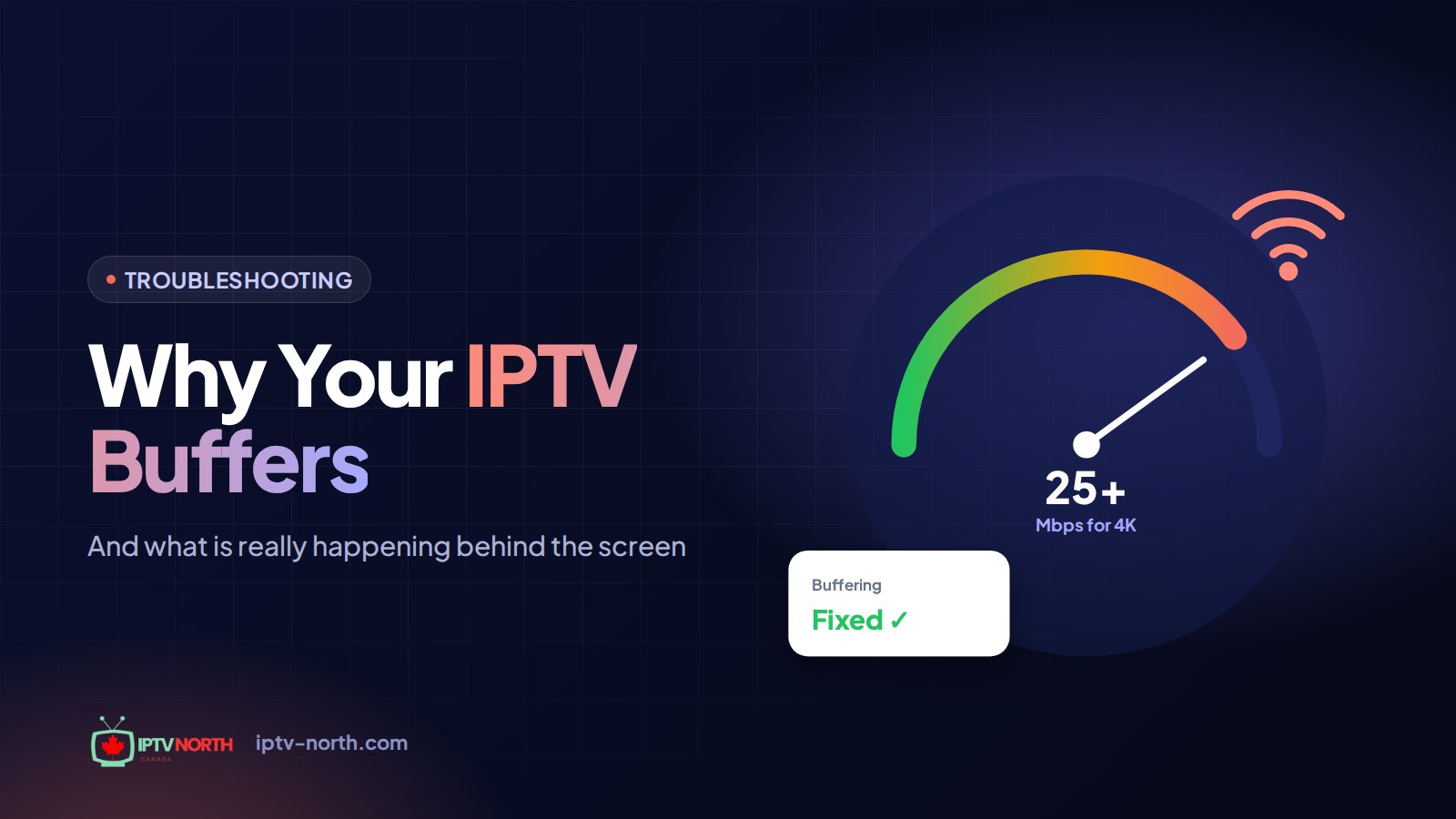
| 4K | 25 Mbps and up | Fibre or fast cable internet |
You can check your real speed at speedtest.net before you start. A wired Ethernet connection to your TV box usually beats Wi-Fi, especially in busy apartment buildings.
From downtown towers to the cottage
- Big cities like Toronto, Montréal, Vancouver and Calgary usually have fast, stable connections suited to 4K.
- Mid-size cities such as Halifax, Winnipeg and Saskatoon handle Full HD with ease on standard plans.
- Rural homes and cottages on fixed wireless or satellite internet can still watch comfortably in SD or 720p.
Devices you probably already own
IPTV North works on Amazon Fire TV Stick, Android TV boxes, Smart TVs, iPhone and iPad, Apple TV, Windows and Mac computers, MAG, BuzzTV and Formuler boxes, and Roku through a simple workaround. Step-by-step setup instructions are in our installation guide.
What You Can Watch With a Canadian IPTV Subscription
A full subscription with IPTV North includes more than 25,000 live channels and a library of over 120,000 movies and series on demand, in 4K and FHD where available. For Canadian viewers, that typically means:
- Hockey nights: NHL games on TSN, Sportsnet and CBC
- Football: CFL action through the summer and the Grey Cup in the fall
- News and local TV: national and regional Canadian channels
- International channels: programming from the US, the UK, Europe, Asia and beyond
Is IPTV Legal in Canada When the Service Costs Less Than Cable?
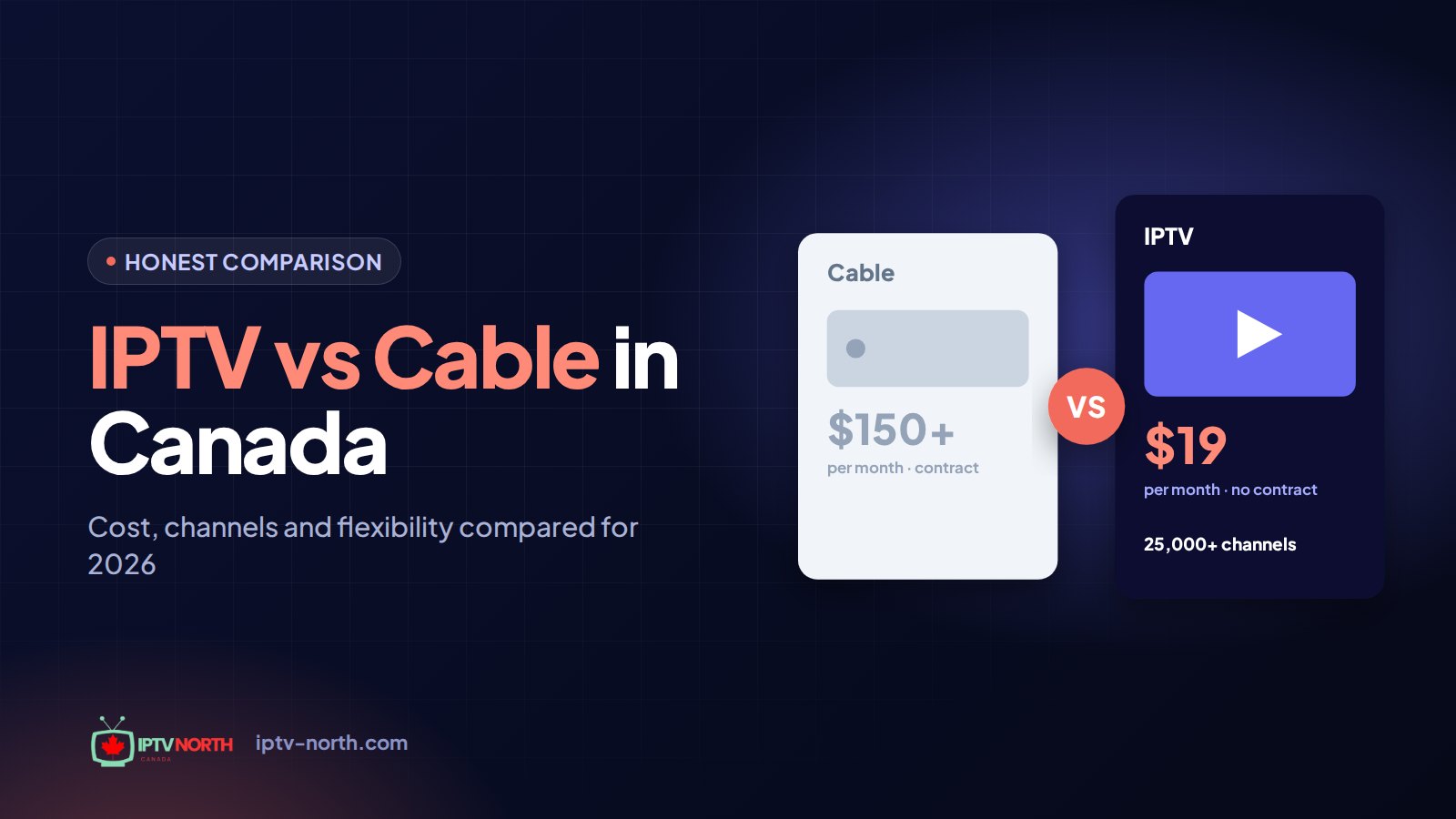
A lower price does not make a service illegal, and a higher price does not make one legitimate. Internet delivery simply removes many costs that cable carries, such as technician visits, rented boxes and physical network upkeep. What matters is the checklist above: transparency, real support, clear policies and a way to test before you pay.
Here is how IPTV North plans compare for one device, in Canadian dollars:
| Plan length | Price (CAD) | What you get |
|---|---|---|
| 1 month | $19 | Full access, no contract |
| 3 months | $29 | Full access, no contract |
| 6 months | $49 | Full access, no contract |
| 12 months | $79 | Full access, no contract |
See every detail on our pricing page.
Getting Started the Careful Way
- Test first. Request the 24-hour trial. It costs $2.99, paid by Interac e-Transfer.
- Try it on your real setup. Watch a live game and a movie on the TV and network you will actually use.
- Ask questions. Our Canadian support team answers 24/7 by chat and at service@iptv-north.com.
- Pick a plan. Pay by Interac e-Transfer, with no contract to sign.
- Install and watch. Follow the guide for your device and you are streaming within minutes.
Curious about the other side of the equation? Our article on whether selling IPTV is legal in Canada looks at the same topic from a reseller's perspective.
Frequently Asked Questions
Can I get in trouble just for watching IPTV in Canada?
The technology itself is lawful. Legal risk is tied to unauthorized content, and enforcement in Canada has focused mostly on people who distribute it. Choosing a transparent service and using it responsibly is the sensible approach. This is general information, not legal advice.
Are IPTV apps and streaming boxes legal to own?
Yes. Player apps, Fire TV Sticks, Android boxes and MAG or Formuler devices are ordinary consumer products. Like any tool, what matters is how they are used and what content they access.
Do I need a VPN to watch IPTV in Canada?
A VPN is not required to use IPTV North. Some viewers choose one for privacy or to avoid congestion on their network, but it does not change the legal picture. Our VPN for IPTV guide covers the pros and cons.
Will IPTV work during a big playoff game?
With a stable connection of at least 10–15 Mbps for Full HD, busy nights run smoothly for most households. If you see stutters, our article on fixing IPTV buffering walks through quick fixes.
Does IPTV North lock me into a contract?
No. Every plan is prepaid for a set period, from one month to twelve, and there is no contract or cancellation fee.
How can I test the service before paying?
Ask for the 24-hour trial. You get full access for $2.99, paid by Interac e-Transfer, so you can judge picture quality and channel selection on your own equipment.
The Bottom Line: Is IPTV Legal in Canada?
For viewers, the answer comes down to this: the technology is legal, the devices are legal, and legality of the content depends on the rights held by whoever distributes it. Use the checklist, favour services with real support and clear policies, and test before you commit. If you want to see how internet TV performs on your own screen this weekend, start with a $2.99 24-hour trial from IPTV North and decide for yourself.